Humic Acids and Chelation in Soil
Understanding How Humic Substances Help Nutrient Availability
By Kent Holle
Healthy soils contain a wide range of organic compounds that influence nutrient availability and soil biology. Among the most discussed of these compounds are humic substances, particularly humic acids. These materials can play an important role in soil fertility by improving nutrient retention, supporting microbial activity, and acting as natural chelating agents.
Understanding how humic acids function begins with understanding the concept of chelation.
What Is Chelation?
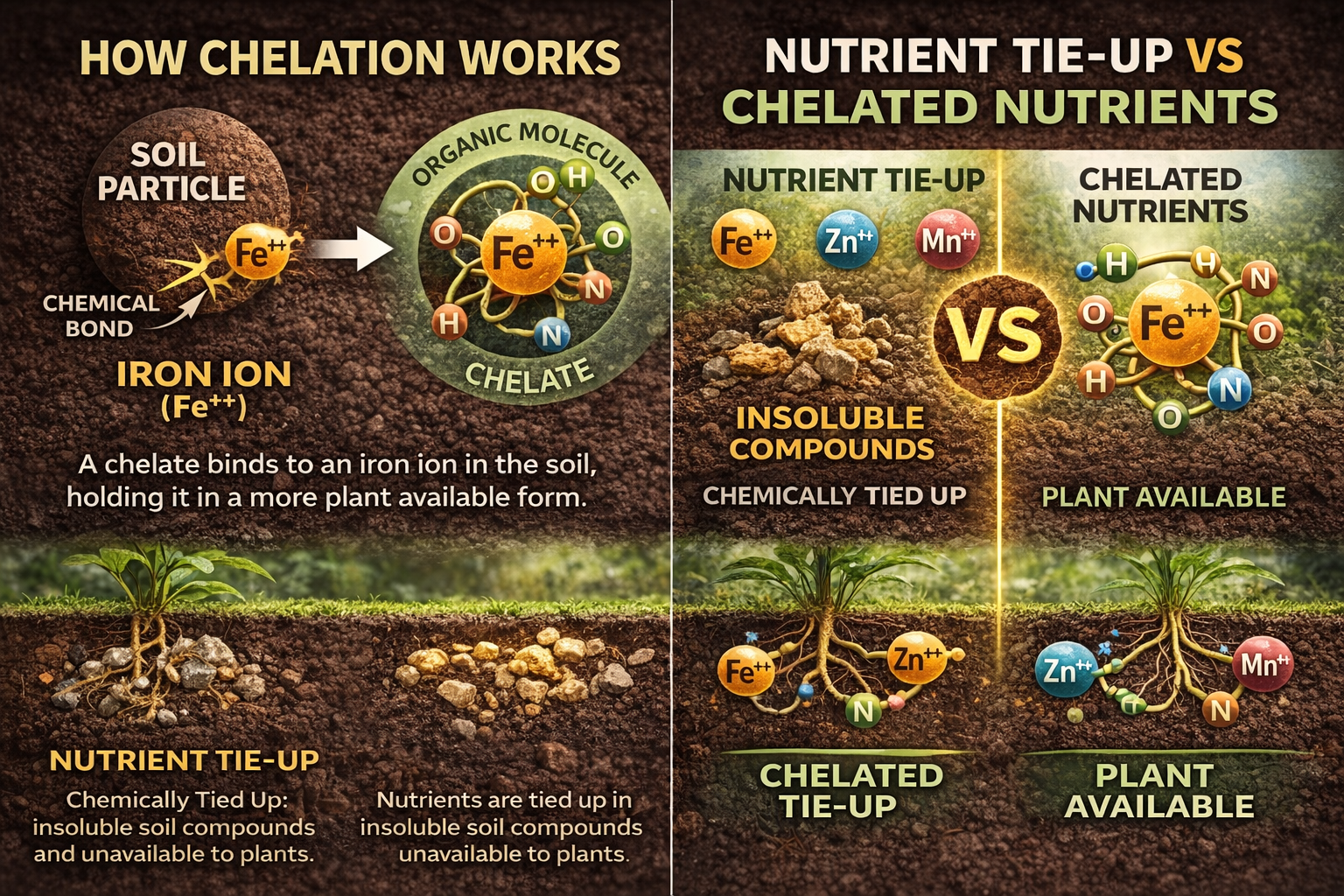
A chelate is a molecule that binds to a nutrient ion and holds it in a form that is more stable and more available for plant uptake.
The word chelate comes from the Greek word chele, meaning claw. This describes how the molecule wraps around and holds onto a nutrient, much like a claw holding an object.
In soil systems, chelation helps prevent certain nutrients from becoming chemically tied up or unavailable to plants.
For example, nutrients such as:
iron
manganese
zinc
copper
can sometimes react with soil minerals and become unavailable to plants. When these nutrients are chelated, they remain in a more soluble and plant-available form.
Many soil microorganisms also produce natural chelating compounds as part of normal soil biological activity.
What Are Humic Acids?
Humic acids are complex organic molecules formed during the long-term decomposition of plant and microbial materials.
They are part of a group of compounds known as humic substances, which include:
humic acid
fulvic acid
humin
These materials are major components of stable soil organic matter.
Humic substances contribute to:
soil structure
nutrient retention
water holding capacity
microbial habitat
They are especially common in soils with high levels of organic matter and biological activity.
Humic Acids as Natural Chelators
Humic acids contain many reactive sites that can bind to mineral nutrients. Because of this, they can function as natural chelating agents in the soil.
When nutrients are loosely associated with humic compounds, they are often less likely to be lost through leaching and may remain available to plants over longer periods.
In this way, humic substances can help:
• improve nutrient efficiency
• reduce nutrient tie-up
• support more balanced nutrient cycling
This is one reason why soils rich in organic matter often show more stable fertility over time.
Relationship With Soil Biology
Humic substances also interact closely with the soil food web.
Microorganisms such as bacteria and fungi contribute to the formation of humic compounds as they decompose organic matter. At the same time, humic substances provide habitat and surfaces that help support microbial communities.
As soil biology processes organic residues and compost, new humic compounds are continually formed.
This is part of the reason why biologically active soils tend to develop stronger nutrient buffering capacity over time.
Humic Acid Products and Soil Management
Commercial humic acid products are often used as soil amendments or additives to fertilizer programs. These products are typically derived from materials such as leonardite, oxidized lignite, or other sources of concentrated humic substances.
In some situations, these products may help support nutrient availability or improve soil organic chemistry. However, their effectiveness often depends on the overall biological and organic matter condition of the soil.
Soils with active microbial communities, regular organic inputs, and healthy root systems naturally produce many humic compounds as part of the soil building process.
A Soil Biology Perspective
From a soil biology standpoint, humic acids are part of a larger system of organic matter transformation and nutrient cycling.
Practices that support the soil food web—such as reducing excessive disturbance, maintaining living roots, and adding biologically active compost—help build the organic matter and microbial activity that ultimately leads to the formation of humic substances.
Rather than relying solely on external inputs, long-term soil health comes from managing the conditions that allow the soil ecosystem to build and maintain these compounds naturally.
ByDesignSoil.com
Practical education for understanding soil biology and the living soil system.