Late Succession Soils and Urban Forest Health
How Fertilizer Practices Can Influence Soil Biology
By Kent Holle
Many urban trees grow in soils that have been heavily disturbed during construction and landscaping. These soils often lack stable organic matter and the diverse biological communities that support long-term tree health.
Understanding soil succession can help explain why some management practices support trees, while others may unintentionally work against them.
Soil Succession and Plant Communities
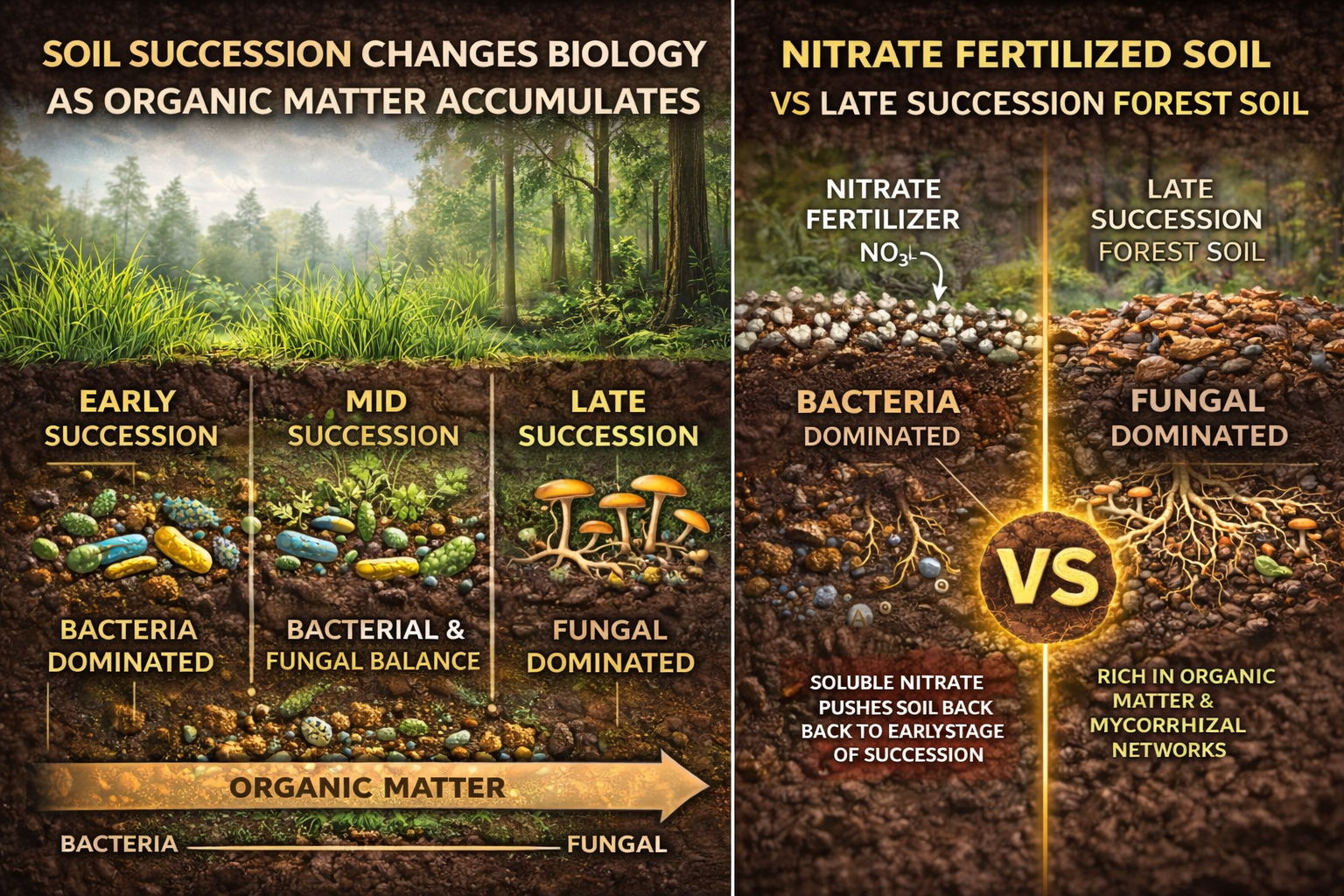
Soil ecosystems develop through a process known as soil succession. Over time, the biological community of the soil changes as organic matter accumulates and microbial populations evolve.
In general:
• Early succession soils are bacterial dominated
• Mid-succession soils support grasses and perennials
• Late succession soils are fungal dominated
Forest ecosystems, including many native tree systems, tend to function best in soils that support strong fungal networks.
Fungi form extensive relationships with tree roots, particularly through mycorrhizal associations, helping trees access water and nutrients over larger soil volumes.
Nitrogen Forms and Soil Biology
Nitrogen is an essential nutrient for plant growth, but the form of nitrogen can influence soil biology in different ways.
Many conventional fertilizers contain nitrogen in the nitrate form (NO₃⁻). Nitrate is highly soluble and readily available to plants, which is why it is commonly used in turf and landscape fertilization.
However, repeated inputs of soluble nitrate can influence soil biology by favoring rapid bacterial growth.
Because bacteria respond quickly to readily available nutrients, large nitrate applications can push the soil ecosystem toward earlier stages of succession.
What This Means for Urban Trees
Urban forests often consist of species that evolved in fungal-dominated forest soils. When soils are repeatedly pushed toward bacterial dominance, several things may occur:
• reduced development of fungal networks
• weakened mycorrhizal relationships
• faster nutrient cycling but less long-term stability
• reduced soil structure and organic matter accumulation
Over time, these changes may make trees more vulnerable to drought stress, pests, and environmental pressures.
Supporting Late Succession Soil Systems
Rather than focusing solely on soluble fertilizer inputs, urban forest management can benefit from practices that support the biological conditions trees evolved with.
Examples include:
• adding compost or organic mulches
• reducing soil disturbance around tree root zones
• maintaining leaf litter or organic surface layers
• encouraging fungal development in the soil
These practices help create conditions that allow fungal networks and mycorrhizal relationships to develop naturally.
A Soil Biology Perspective
Healthy forest soils are not simply nutrient reservoirs; they are living biological systems shaped by long-term ecological processes.
Management practices that support fungal-dominated soil biology can help urban trees function more like their counterparts in natural forest ecosystems.
Understanding soil succession allows land managers, arborists, and homeowners to work with the biology of the soil rather than unintentionally resetting it.
ByDesignSoil.com
Understanding soil biology and the living soil system.