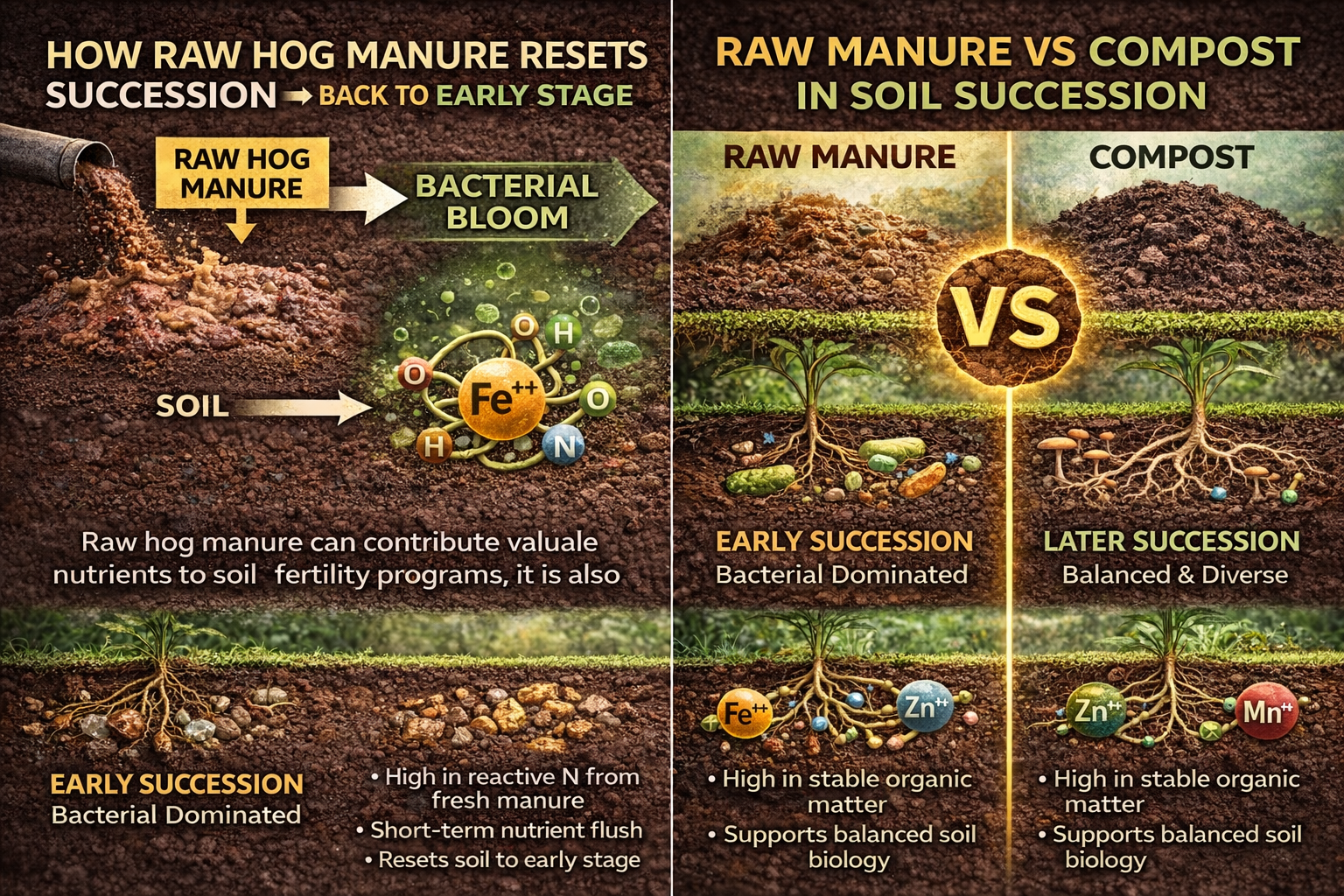
Raw Hog Manure and Soil Succession
How Manure Applications Influence Soil Biology
By Kent Holle
Livestock manure has long been used as a valuable source of nutrients and organic matter in agricultural soils. Raw hog manure from farrowing and feeder facilities is commonly applied to crop fields because it contains significant amounts of nitrogen, phosphorus, potassium, and organic carbon.
While manure can contribute valuable nutrients to soil fertility programs, it is also important to understand how large applications of fresh manure influence the biological succession of the soil system.
Soil Succession and Biological Balance
Soil ecosystems develop over time through a process known as soil succession. As organic materials are processed by microorganisms, the soil food web gradually shifts from bacterial dominance toward greater fungal development.
Different plant systems tend to function best at different stages of this biological succession.
For example:
• Annual crops often perform well in more balanced soils
• Perennial grasses tend to prefer balanced bacterial and fungal populations
• Forest systems are typically fungal-dominated
Management practices can influence where a soil sits along this succession pathway.
Why Raw Manure Favors Bacterial Activity
Fresh manure, particularly liquid or slurry hog manure, contains large amounts of readily available carbon and nitrogen.
These materials serve as an immediate food source for bacteria. Because bacteria reproduce very quickly, they rapidly respond to fresh organic inputs.
This often leads to a temporary surge in bacterial populations following manure applications.
In many cases, this biological response can shift the soil system toward earlier stages of succession, where bacterial activity dominates and fungal populations may be temporarily suppressed.
This effect is similar to what occurs after other disturbances such as tillage or heavy nutrient inputs.
Nutrient Cycling After Manure Applications
As bacteria rapidly consume fresh manure materials, nutrients are processed through the soil food web.
This can lead to:
• rapid nutrient mineralization
• short-term increases in plant available nitrogen
• increased microbial respiration
However, because much of the material in fresh manure is easily decomposed, the biological response is often short-lived.
Over time, soils tend to move back toward a more balanced biological system as microbial communities stabilize and more complex organic materials accumulate.
Long-Term Soil Health Considerations
Manure can be an important component of soil fertility programs when managed carefully. However, large or repeated applications of fresh manure may tend to keep soils cycling through early bacterial stages of succession.
To support long-term soil health and biological balance, manure applications are often most effective when combined with practices that help build stable organic matter and fungal habitat.
Examples include:
• maintaining living plant roots
• reducing excessive soil disturbance
• adding compost or more stabilized organic materials
• increasing plant diversity through cover crops
These practices help support a broader soil food web and allow soils to gradually move toward more stable biological conditions.
A Soil Biology Perspective
From a soil biology standpoint, manure is best viewed as one input within a larger soil ecosystem.
Fresh manure can stimulate microbial activity and nutrient cycling, but long-term soil health ultimately depends on building stable organic matter and supporting a diverse soil food web.
Understanding how different inputs influence soil succession allows growers to better manage soils for both crop productivity and biological resilience.
ByDesignSoil.com
Understanding soil biology and the living soil system.